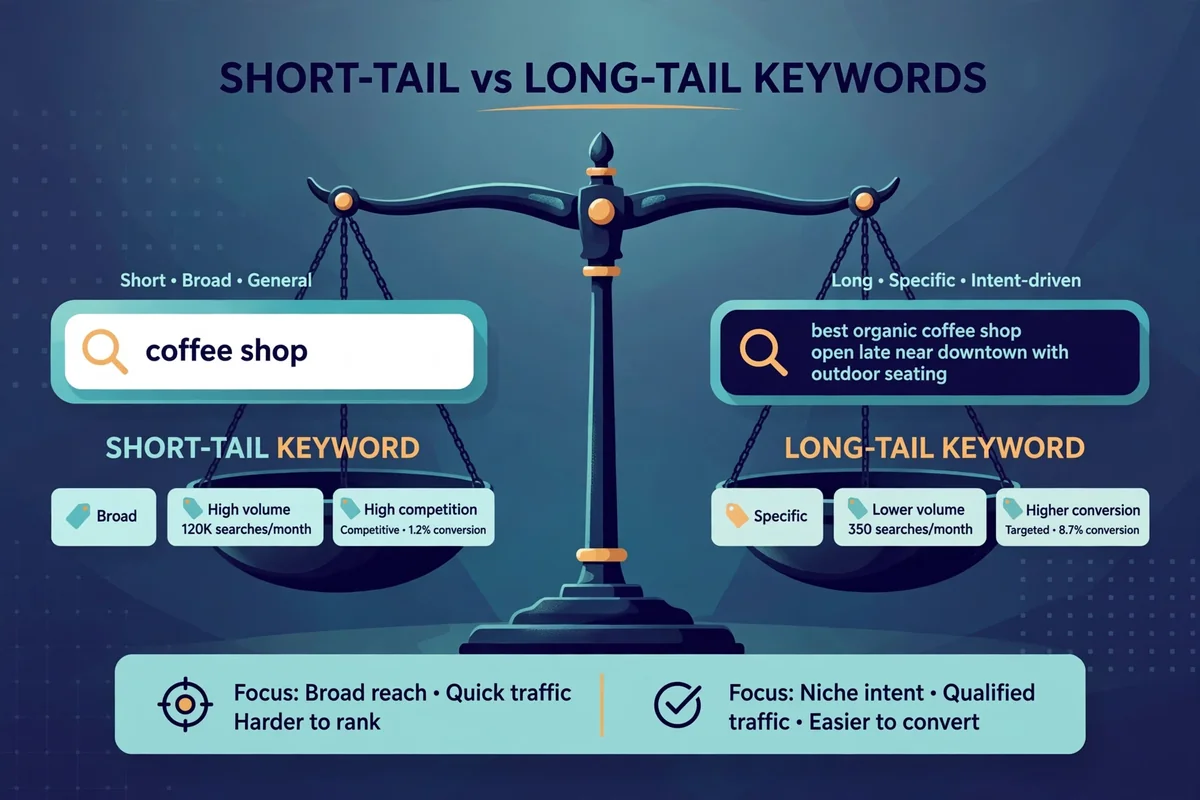
Not all keywords are equal. Some are short, broad, and highly competitive. Others are longer, more specific, and much easier to rank for — especially for a new or growing site.
Understanding short-tail vs long-tail keywords helps you choose targets you can actually win, instead of chasing terms that are out of reach for now.
What is a short-tail keyword?
A short-tail keyword, also called a head term, is usually 1 to 2 words, very broad, and searched a lot.
Examples:
- “SEO”
- “digital marketing”
- “guest posting”
Characteristics:
- High search volume
- High competition
- Broad, unclear intent — the searcher could want many different things
- Harder to rank for, especially for a new site
- Lower conversion rate per visit, because intent is vague
Short-tail keywords are useful for understanding a topic area, but they are rarely the best first target.
What is a long-tail keyword?
A long-tail keyword is usually 3 or more words, more specific, and searched less often individually — but there are many more of them in total.
Examples:
- “what is on-page SEO for beginners”
- “how to do keyword research for a small blog”
- “best free SEO tools for beginners in 2026”
Characteristics:
- Lower search volume per keyword
- Lower competition
- Clearer intent — you know what the searcher wants
- Easier to rank for
- Higher conversion rate, because the page can match the exact need
Long-tail keywords are where most small and medium sites get their early traffic.
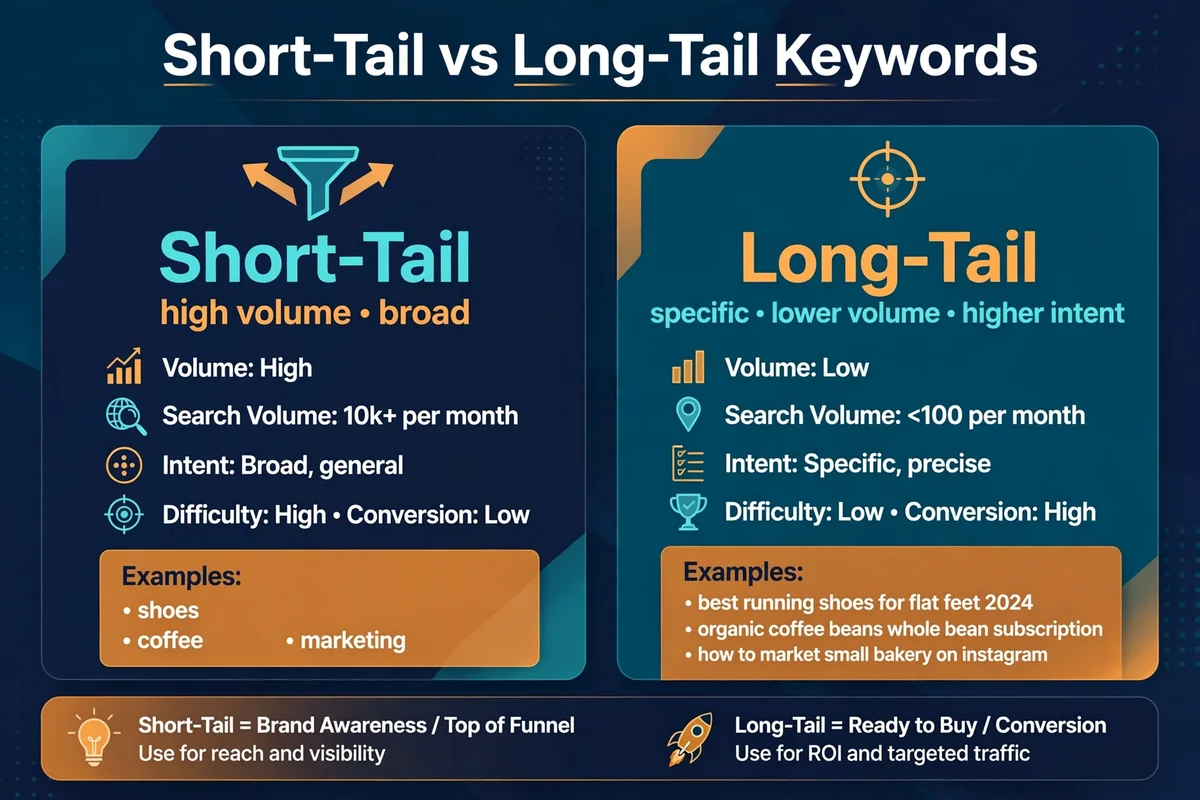
Short-tail vs long-tail at a glance
- Length: short-tail is 1-2 words; long-tail is 3+ words, often a phrase or question.
- Volume: short-tail is high per keyword; long-tail is low per keyword, high in total.
- Competition: short-tail is high; long-tail is low to medium.
- Intent: short-tail is vague; long-tail is specific.
- Best for: short-tail for broad authority over time; long-tail for quick, targeted wins.
Examples in the same topic
Topic: SEO
- Short-tail: “SEO”
- Medium-tail: “on-page SEO”
- Long-tail: “on-page SEO checklist for beginners”
- Very long-tail: “how to write an on-page SEO checklist for a WordPress blog”
Topic: guest posting
- Short-tail: “guest posting”
- Long-tail: “how to pitch a guest post to a digital marketing blog”
- Long-tail: “guest posting sites for healthcare blogs in 2026”
The longer version tells you exactly what content to write. The short version does not.
When to use each type
Use short-tail keywords when:
- You are planning a pillar page or category page that covers a broad topic
- You already have authority in that topic and can compete
- You want to organise long-tail content under a broader theme
Use long-tail keywords when:
- You are starting out or have a smaller site
- You want traffic sooner, not just eventually
- You are writing a specific guide, tutorial, or comparison
- You want visitors who are more likely to take action
A good strategy uses both: broad pages for short-tail topics, supported by many specific long-tail articles that link back to them. That structure is called a topic cluster.
Learn more about clusters here: Topic Clusters Explained is a remaining topic in our plan, and our existing guides show the pattern in practice.
How to find long-tail keywords
- Start with a short-tail seed, such as “SEO” or “keyword research.”
- Add question words: how, what, why, when, best, vs, for beginners.
- Check Google’s autocomplete and People Also Ask for real phrasing people use.
- Look at Search Console queries for your own site — the longer queries that already bring impressions are often long-tail opportunities.
- Check the search results: if the top pages are thin or outdated, a better, more specific page has a real chance.
Related guides on Ranking Bridge:
- How to Do Keyword Research for SEO Step-by-Step
- What Are Keywords in SEO? Why They Matter for Rankings
- How to Find Low-Competition Keywords That Rank
Google’s SEO Starter Guide also warns against keyword stuffing and stresses natural, helpful content over repeating terms. Read it here: Google Search Central, SEO Starter Guide
Common mistakes to avoid
- Only targeting short-tail keywords and getting no traffic for months.
- Stuffing a long-tail phrase into a page repeatedly. Use it naturally in the title, first paragraph, and headings, then write normally.
- Creating a separate thin page for every tiny variation. Group close variations into one strong page.
- Ignoring intent. A long-tail keyword with clear transactional intent needs a different page than one with informational intent. See: What Is Search Intent?
A simple starter plan
For your next 10 posts, try this mix:
- 1 broad pillar page for a short-tail topic
- 7 to 8 long-tail guides that support that pillar and link to it
- 1 to 2 comparison or “best of” posts for commercial intent
That mix gives you realistic ranking chances now, while building authority for broader terms over time.