

Generative AI is everywhere right now. It dominates industry conferences, fills LinkedIn timelines, and is changing the way many companies think about organic search.
Brands are scrambling to optimize for AI Overviews, experiment with vector embeddings, build semantic clusters, and redesign content strategies around LLMs.
But here’s the overlooked truth: for most websites, AI-driven platforms still account for only a small fraction of total traffic.
Yes—AI search is growing.
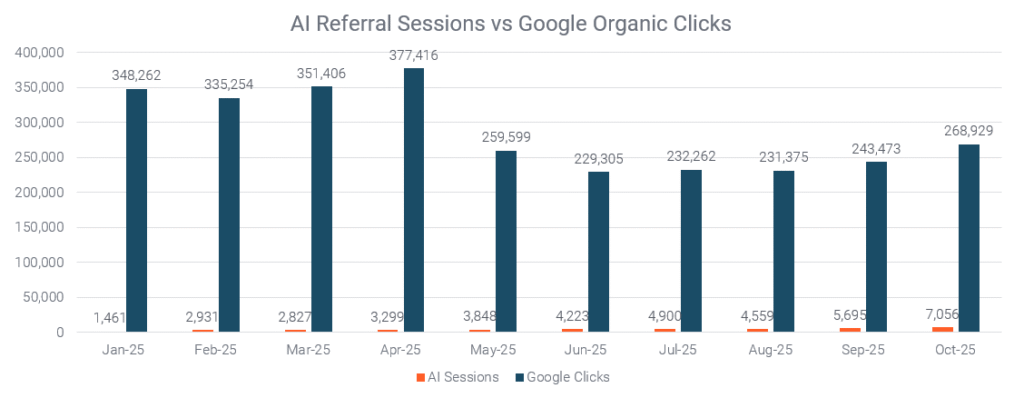
But in many cases, all LLM platforms combined represent only about 2–3% of the organic traffic Google delivers on its own.
Despite that reality, countless teams are prioritizing AI-led strategies over foundational SEO work that continues to deliver predictable, measurable gains.
In other words—many companies are overinvesting in what’s coming next while underperforming in what matters right now.
This article explores how focusing too narrowly on AI trends can distract from proven SEO fundamentals—and shows, with real examples, that these basics still drive meaningful performance today.
1. Simple SEO optimizations still generate big results
In a world where people obsess over embeddings and semantic analysis, it’s easy to forget that small SEO updates can still lead to massive performance gains.
Title tags are a perfect example.
They’re one of the easiest on-page elements to optimize, yet so many websites get them wrong—by missing keywords, targeting weak terms, or not optimizing them at all.
Recently, a client saw a major improvement simply by adding “& [keyword]” to their homepage title tag.
No other changes. No content rewrite. No complex strategy.
Within days, rankings improved—and clicks and impressions for that keyword surged.
One tag. One page. Big results.
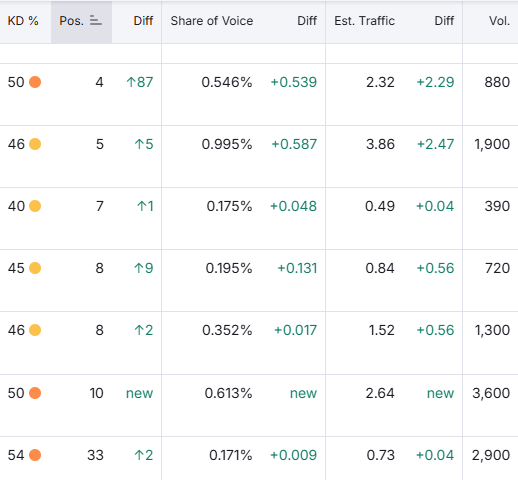
Layer in other fundamentals—on-page copy updates, internal links, and strategic backlinks—and growth compounds.
Yes, it sounds basic.
But it still works.
And if you focus only on advanced GEO or AI-driven strategies, you risk missing these fast, high-impact wins.
2. Fresh, authoritative content still wins competitive rankings
Another proven tactic quietly getting ignored in the AI conversation is the classic “skyscraper” approach.
The idea is simple:
- Identify keywords that already drive traffic
- Study the content that ranks
- Publish something significantly better
Even though the web is full of similar content, this approach still works—especially when:
- your site has authority
- your content is genuinely stronger
- competing articles are outdated
I’ve seen this repeatedly.
One client published a refreshed article on a crowded topic—and it jumped to the #2 position almost immediately, generating entirely new clicks and impressions.
Why?
Because the competition was stale—and Google rewards relevance and quality.
This strategy isn’t universal. It won’t work for every site or every keyword.
But ignoring it completely means walking past proven, high-confidence growth opportunities.
3. User experience still drives conversions—no matter the traffic source
With AI-powered shopping and conversational interfaces gaining attention, some teams are assuming that traditional website optimization soon won’t matter.
Yes, AI-based commerce and even in-platform conversions are developing.
But most brands still rely on their websites to convert traffic—and for many, organic search remains the largest pipeline.
And no matter how people arrive onsite—organic, paid, AI referrals, or direct—the basics still matter:
- fast pages
- intuitive navigation
- clear CTAs
- friction-free funnels
We recently ran a straightforward CTR-focused UX test for a client—and the results were immediate and measurable.
Brands that keep optimizing for real users will continue to outperform those that assume AI will soon replace the funnel entirely.
And the longer companies wait, the wider that performance gap will become.
AI is transforming search—but fundamentals still win
There’s no debate: AI is reshaping search behavior, SERPs, and attribution.
But the bigger risk for most businesses isn’t ignoring AI—it’s overcorrecting for it.
Organic search still drives the majority of traffic for most websites.
And when executed well, SEO fundamentals still deliver:
- Quick wins are real
- High-quality content still ranks
- UX optimization continues to lift conversions
And importantly—these efforts reinforce everything else:
- Better SEO strengthens paid search
- Stronger websites improve AI visibility
- Quality content feeds every channel
Yes—stay informed. Plan for what’s coming.
But don’t abandon the strategies that are already driving results today.
Because while AI continues to evolve, the fundamentals of search still determine who gets seen—and who doesn’t.