

In digital marketing, businesses often hear the terms SEO, SEM, and PPC used interchangeably. While they are closely related, each serves a different purpose and plays a unique role in driving traffic, leads, and revenue. Understanding the difference between SEO vs SEM vs PPC is essential for building a profitable online marketing strategy.
This guide breaks down each concept clearly, explains how they work, and helps you decide which approach is best for your business.
What Is SEO (Search Engine Optimization)?
SEO (Search Engine Optimization is the process of optimizing your website to rank higher in organic (unpaid) search engine results.
How SEO Works
SEO focuses on improving your website’s:
- Content quality (useful, keyword-rich information)
- Technical performance (site speed, mobile-friendliness, indexing)
- Authority & backlinks (trusted links from other websites)
- User experience (easy navigation, low bounce rate)
Search engines like Google analyze these factors to determine where your website should rank.
Key Types of SEO
- On-Page SEO – Keywords, meta tags, headings, content optimization
- Off-Page SEO – Backlinks, brand mentions, authority building
- Technical SEO – Page speed, schema, crawling, indexing
Pros of SEO
- Free organic traffic
- Long-term results
- Builds brand trust and authority
- High ROI over time
Cons of SEO
- Takes time (weeks or months)
- Requires consistent effort
- Algorithm changes can affect rankings
What Is PPC (Pay-Per-Click)?
PPC (Pay-Per-Click) is an online advertising model where you pay each time someone clicks on your ad.
The most common PPC platform is Google Ads, but PPC also exists on:
- Bing Ads
- Facebook Ads
- Instagram Ads
- LinkedIn Ads
How PPC Works
You bid on keywords, and your ad appears at the top of search results or on social platforms. You only pay when a user clicks your ad.
Common PPC Ad Types
- Search ads (Google search results)
- Display ads (banner ads on websites)
- Shopping ads (eCommerce products)
- Remarketing ads (targeting past visitors)
Pros of PPC
- Instant visibility
- Highly targeted traffic
- Full budget and audience control
- Easy to measure ROI
Cons of PPC
- Traffic stops when budget stops
- Can be expensive in competitive niches
- Requires continuous optimization
What Is SEM (Search Engine Marketing)?
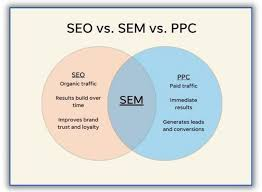
SEM (Search Engine Marketing) is a broader term that includes both SEO and PPC strategies used to increase visibility on search engines.
SEM Includes:
- Organic search optimization (SEO)
- Paid search advertising (PPC)
In modern usage, many marketers use SEM to refer specifically to paid search advertising, but technically, SEO is also part of SEM.
SEM Goal
The primary goal of SEM is to maximize search engine presence—both paid and organic—to drive traffic, leads, and sales.
SEO vs SEM vs PPC: Key Differences
| Feature | SEO | PPC | SEM |
|---|---|---|---|
| Cost | Free (time & effort) | Paid per click | Paid + organic |
| Traffic Speed | Slow but steady | Immediate | Immediate + long-term |
| Sustainability | Long-term | Short-term | Balanced |
| Trust Level | High | Medium | High |
| Control | Limited | High | High |
| Best For | Brand growth | Quick sales | Full search coverage |
When Should You Use SEO?
SEO is ideal if:
- You want long-term growth
- You have limited ad budget
- You want consistent organic traffic
- You are building authority in your niche
Best for blogs, service websites, SaaS, and content-driven businesses.
When Should You Use PPC?
PPC is best if:
- You need immediate traffic
- You are launching a new product
- You want fast conversions
- You are targeting competitive keywords
Best for eCommerce, promotions, local services, and lead generation.
When Should You Use SEM?
SEM is ideal if:
- You want maximum visibility on search engines
- You can invest in both SEO and paid ads
- You want short-term results + long-term growth
- You want to dominate competitive keywords
Large businesses and growing brands benefit most from SEM.
SEO vs SEM vs PPC: Which Is Best?
There is no single “best” option—it depends on your goals:
- Short-term results → PPC
- Long-term growth → SEO
- Complete search strategy → SEM
The most successful digital marketing strategies combine SEO and PPC for sustainable and scalable growth.
FAQs
1. What is the main difference between SEO, SEM, and PPC?
SEO focuses on organic search rankings, PPC involves paid ads charged per click, and SEM is the overall search marketing strategy that includes both SEO and PPC.
2. Is PPC part of SEM?
Yes, PPC is a core component of SEM. SEM includes all paid and organic tactics used to improve visibility in search engines, while PPC specifically refers to paid ads.
3. Is SEO better than PPC?
Neither is better overall—it depends on your goals.
- SEO is better for long-term, cost-effective traffic.
- PPC is better for quick results, promotions, and immediate conversions.
4. How long does SEO take to show results?
SEO usually takes 3 to 6 months to show noticeable improvements, depending on competition, content quality, and backlink strength.
5. Does traffic stop if I stop PPC ads?
Yes. Once you pause or stop PPC campaigns, your paid traffic stops immediately, unlike SEO, which continues to bring organic traffic.
Final Thoughts
SEO, SEM, and PPC are not competitors—they are complementary strategies. SEO builds trust and long-term visibility, PPC delivers fast traffic and conversions, and SEM combines both to dominate search results.
If you want a powerful digital marketing strategy, use SEO for stability, PPC for speed, and SEM for maximum impact.