
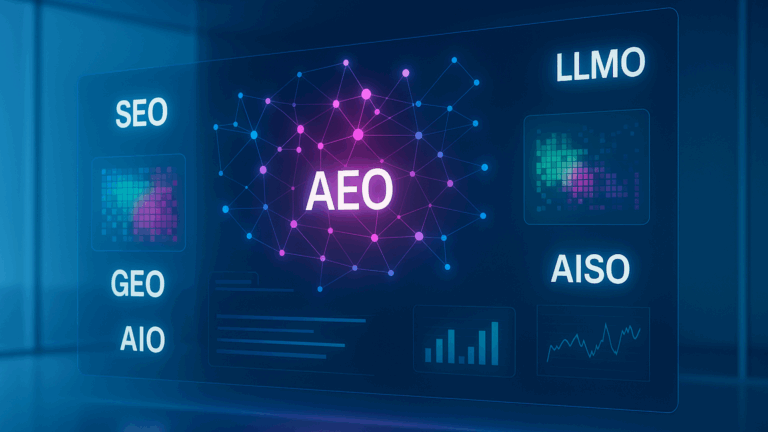
The digital landscape is shifting faster than ever. Search is no longer limited to typing keywords into Google. Instead, users are increasingly turning to AI assistants, generative search engines, voice-driven responses, app ecosystems, and personalized recommendation feeds. This evolution raises an important question:
What do we call brand visibility in the age of AI?
For years, marketers relied on three main concepts:
- SEO (Search Engine Optimization) to rank on traditional search engines
- GEO (Generative Engine Optimization) to appear in AI-generated results
- ASO (App Store Optimization) to rank in mobile app stores
But today’s environment is far more complex. It merges search, AI, media, user intent, and platform behavior into one blended ecosystem. In this research-backed analysis, we’ll explore which term best fits the new era — and how brands should adapt their visibility strategies moving forward.
The Shift: From Search Engines to AI Ecosystems
The old model was simple:
Users searched → Search engines indexed → Websites ranked → Traffic came in.
But with the rise of AI systems like:
- ChatGPT Search
- Gemini Search
- Perplexity
- OpenAI Browse
- Bing Copilot
- AI-powered SERP snapshots
- Social AI recommendations
- App-store level decisioning
…the user journey looks completely different.
Instead of 10 blue links on Google, we now have AI summaries, zero-click answers, conversational responses, and multimodal results that may not link anywhere at all.
This shift changes the nature of visibility. Brands are no longer competing just for rankings — they’re competing for representation in AI knowledge models.
That’s bigger than SEO.
It’s broader than ASO.
And it goes beyond GEO.
SEO: Still Alive, But No Longer Enough
Search Engine Optimization has been the backbone of digital marketing for decades. Even today, SEO matters. Organic traffic remains one of the most profitable channels, and billions of searches still occur on Google daily.
But the role of SEO is changing.
Why SEO Alone Doesn’t Cover the AI Era
- AI-generated answers reduce click-through rates.
Many queries are answered directly in SERP through AI overviews. - Search engines now rely on LLMs for ranking and interpretation.
This changes how content relevance is measured. - Websites are no longer the only source.
AI models pull data from multiple sources — including forums, videos, PDFs, reviews, and even app content. - User behavior signals are shifting.
Voice, chat-based queries, and mobile-first interactions influence visibility.
While SEO remains essential, it no longer covers the full journey of discovery. It is one piece of a much larger ecosystem.
GEO: The Rise of Generative Engine Optimization
In 2023–2025, digital marketers began using the term GEO (Generative Engine Optimization) to describe optimization for AI engines like ChatGPT, Perplexity, and Gemini.
GEO focuses on:
- Training AI models to reference your brand
- Structuring content for AI retrieval
- Improving factual accuracy in AI responses
- Aligning with schema and knowledge graph data
- Being mentioned in authoritative sources
- Optimizing for zero-link answers
This is a newer discipline, and one that will grow dramatically.
Why GEO Matters Now
AI engines have become information decision-makers. They:
- Summarize product comparisons
- Recommend brands
- Explain services
- Rank options in conversational form
- Provide step-by-step guidance
- Answer niche queries without requiring a click
If your brand isn’t included in these summaries, you lose visibility even if your website ranks #1 in traditional search.
GEO is about becoming part of the AI-generated conversation.
But does GEO cover everything? Not quite.
ASO: Rising Importance as App Ecosystems Grow
App Store Optimization has historically focused on ranking apps within:
- Google Play
- Apple App Store
- Galaxy Store
- Huawei AppGallery
But in 2025 and beyond, ASO plays a new role in the AI ecosystem:
Why ASO Is Gaining Power Again
- AI assistants frequently recommend apps.
Voice assistants often surface apps as solutions. - Users solve problems through apps rather than searches.
- AI-driven app recommendation systems mimic SERP logic.
- App metadata contributes to AI knowledge models.
ASO is no longer separate from SEO and GEO — it’s becoming part of an integrated visibility strategy across all platforms.
So What Do We Call This New Era? SEO, GEO, or ASO?
The truth is:
None of these individually describe the full picture.
The AI era blends search, discovery, conversation, and recommendations across multiple ecosystems. Visibility today depends on:
- Search engines
- AI assistants
- App stores
- Social networks
- Short-form video algorithms
- Retail marketplaces
- Knowledge graphs
- Multimodal LLMs
- Voice interfaces
This calls for a term that goes beyond the old silos.
Introducing: Intelligent Visibility Optimization (IVO)
A new framework for AI-first brand visibility
While SEO focuses on search engines, GEO on generative engines, and ASO on app ecosystems…
IVO covers the entire universe of AI-driven discovery.
IVO = The practice of optimizing your brand’s visibility across all intelligent systems, including:
- Search engines
- AI models
- Large language models
- Conversational engines
- Multimodal platforms
- Recommendation systems
- App discovery engines
- Voice assistants
- Retail and marketplace algorithms
In short:
IVO = visibility optimization for every AI-powered environment where users make decisions.
Why IVO Is the Future — Backed by Research & Trends
- AI engines are merging with search.
Google, OpenAI, Microsoft, and Perplexity now blend search + AI in one interface. - Users rely more on recommendations than traditional searches.
TikTok, Instagram, and YouTube act as the new search engines — powered by AI. - Query types have changed.
People ask for opinions, comparisons, summaries, and guidance — things AI excels at. - Brand visibility now depends on structured knowledge.
Knowledge graphs, schema markup, citations, and factual consistency matter more than keywords. - The customer journey is multi-platform.
A user might start on TikTok, check reviews on Google, compare brands via ChatGPT, and make a purchase in an app.
This is why the old divisions no longer make sense.
Components of Intelligent Visibility Optimization (IVO)
To succeed in the AI era, brands must optimize across the following pillars:
1. Search Optimization (SEO 2.0)
Enhance website structure, content depth, and authority signals.
2. Generative Engine Optimization (GEO)
Ensure AI tools present your brand accurately and prominently.
3. Knowledge Graph Optimization
Strengthen structured data, schema, and brand entities.
4. Content Intelligence Optimization
Create factual, high-quality, consistent content that models can trust.
5. Recommendation Algorithm Optimization
Improve performance on social, video, shopping, and feed-based platforms.
6. App Ecosystem Optimization (ASO+)
Ensure app-related metadata feeds into AI and search ecosystems.
7. Voice & Conversational Optimization
Prepare your brand for voice-first and AI-chat-first interactions.
IVO brings all of these together.
Which Term Should Marketers Use Going Forward?
If you want to describe:
| Focus | Best Term |
|---|---|
| Only traditional search ranking | SEO |
| AI-generated search results | GEO |
| App Store ranking | ASO |
| All AI-driven discovery & visibility | IVO |
The world is moving toward integrated brand visibility, and the term IVO captures the full scope better than SEO, GEO, or ASO alone.
Final Thoughts: Embrace the AI Visibility Era
We’re entering a new age where AI decides what information users see. This transforms how brands gain visibility, trust, and authority online.
Instead of asking:
“Is it SEO or GEO or ASO?”
We should be asking:
“How can my brand stay visible across all intelligent systems?”
That shift in mindset is exactly why Intelligent Visibility Optimization (IVO) is emerging as the future of digital growth.